5 Rust Concepts That Make Code Reliable
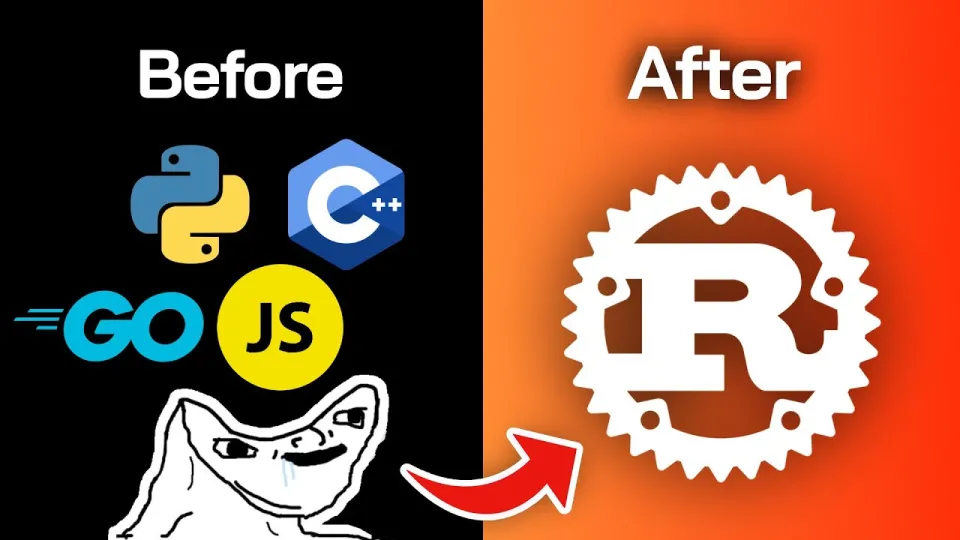
Video: Rust for Dummies in 12 Minutes
You can order the same kind of articles for your own video to boost it on YouTube and Google. Just message the Telegram bot @sat_sit_bot. It writes articles around your video, embeds the video and publishes them on popular niche websites (no ads). Try it free: 50 articles on us.
Rust is a systems programming language that guarantees memory safety and thread safety at compile time, without a garbage collector. Its core concepts—ownership, borrowing, lifetimes, sum types, and pattern matching—work together to eliminate entire classes of bugs such as null pointer dereferences and data races. To get started with a structured roadmap, join the Rust Live Accelerator waitlist.
Why Rust code doesn't break: ownership and borrowing
Ownership is Rust's most distinctive feature: every value has exactly one owner, and when the owner goes out of scope, the value is dropped. This eliminates double frees and use-after-free errors common in C and C++. Borrowing lets you temporarily use a value without taking ownership, either immutably (&T) or mutably (&mut T). The compiler enforces that you can have either multiple immutable borrows or one mutable borrow at a time, preventing data races at compile time. Lifetimes annotate how long references are valid, ensuring they never outlive the data they point to. Together, these rules make memory safety a compile-time guarantee.
The genius of Rust's type system: sum types and no null
Rust's type system includes sum types via enums, which can hold different variants with associated data. The most common example is Option<T>, which represents either Some(value) or None, eliminating null pointer exceptions. Similarly, Result<T, E> handles errors explicitly, forcing you to address failure cases. Because enums are exhaustive, the compiler ensures you handle every possible variant when using match. This design makes illegal states unrepresentable and catches logic errors early. Unlike languages with null, Rust requires you to explicitly opt into absence, leading to more robust code.
Pattern matching and error handling with match
Pattern matching is a control flow construct that destructures enums and ensures all cases are covered. The match expression compares a value against patterns and executes the corresponding arm; the compiler checks that all possible variants are handled, preventing runtime surprises. For error handling, match on Result<T, E> forces you to deal with both Ok and Err, encouraging explicit error propagation. This approach replaces exceptions and makes error paths visible in the code. Combined with sum types, pattern matching provides a powerful way to write concise, safe logic.
Common doubts from developers learning Rust
Many beginners wonder if Rust is too hard, especially those coming from JavaScript or Python. The ownership model often feels restrictive at first, but it becomes intuitive with practice. Another frequent concern is the comparison with modern C++: while C++ has smart pointers, Rust's ownership is enforced globally and checked at compile time, preventing entire classes of bugs without runtime overhead. Developers also ask about compile-time errors—yes, the compiler catches many issues before running the code, which can be frustrating but ultimately saves debugging time. Finally, Rust's ecosystem and tooling (Cargo, Clippy) are praised for making development smoother.
Resources and next steps
The video breakdown by Let's Get Rusty covers these concepts in 12 minutes, but hands-on practice is essential. Start with small projects like a command-line tool or a web server using frameworks like Actix or Rocket. The official Rust Book and Rustlings exercises are excellent free resources. For a guided path, consider joining the Rust Live Accelerator waitlist to access a job-ready roadmap and expert feedback. Engaging with the community through forums and open-source contributions also accelerates learning.
Summary
Rust's ownership, borrowing, and type system provide compile-time guarantees that prevent memory errors and data races. By embracing sum types, pattern matching, and explicit error handling, you write code that is both safe and expressive. While the learning curve exists, the compiler acts as a helpful guide, and the long-term benefits in reliability and performance are substantial. For a concise visual explanation, check out the Let's Get Rusty video breakdown, and take the next step by joining the Rust Live Accelerator waitlist to accelerate your journey.
Key takeaways
- Rust enforces memory safety at compile time without a garbage collector.
- Ownership rules ensure each value has a single owner; borrowing allows temporary access.
- The type system includes sum types (enums) and no null; Option<T> handles absence.
- Pattern matching with match forces handling of all enum variants.
- Rust's compiler errors are descriptive and guide fixes, reducing debugging time.
Source: Rust for Dummies in 12 Minutes · Markdown version
Questions & answers
Is Rust really as hard as people say?
Rust has a steep learning curve primarily due to ownership and borrowing, but these concepts become intuitive with practice. Many developers find that after the initial hurdle, the compiler's feedback makes development smoother and less error-prone.
How does Rust compare to C++ in terms of memory safety?
Rust enforces memory safety at compile time through ownership and borrowing, eliminating data races and null pointer dereferences without a garbage collector. Modern C++ uses smart pointers for similar safety, but Rust's guarantees are global and checked by the compiler, preventing more bugs by default.
Can I use Rust for web development?
Yes, Rust is increasingly used for web backends with frameworks like Actix Web, Rocket, and Axum. It offers performance and safety benefits, and the ecosystem is growing with tools for databases, templating, and authentication.
What are the most important Rust concepts for beginners?
Focus on ownership, borrowing, lifetimes, sum types (enums), and pattern matching. These form the foundation of Rust's safety guarantees and are essential for writing idiomatic code.